

more sporty designs, and more environmentally friendly engines-including a "hybrid"
car that can get 66 miles per gallon on a combination of gasoline and electricity. "Every
maker is preparing new launches to keep sales from falling through the floor," says
Christopher Redl, automotive analyst at ING Barrings Ltd.
But Japanese consumers are al ready overwhelmed
choices. "There are now
over 190 car models available in the market," says Atsushi
member of the board of
directors in charge of domestic sales at Nissan Motor Co.
the
consumer
can only remember about 11 of them."
Yet at the Motor Show, Japanese carmakers will be coming out with even more.
Toyota wants to target young people with fun European-looking models and convertible
sports car. Toyota also plans to roll out the world ' s fi rst mass-produced hybrid, with sales
projected at 1,000 a month. The company admits it will see the hybrid as one-third of the
world's auto market by 2005. After working out the kinks in the hybrid in Japan,
plans to take it for a spin in overseas markets. However,
worry the hybrid could
cannibalize sales of other models. "Why would you want to buy a Corona when you
might be able to buy a hybrid car for just about the same price?" asks Edward Brogan,
automotive analyst at
Brothers Inc.
In this chapter we will look at
special cha1 1enges that the marketing of products
possess. Moreover, we will delineate the unique characteristics associated with products
as they pass through the various stages of
lives. Particular attention will be given to
the kinds of decisions that are necessary through this process.
SOURCES: Jean Halliday, "Carmakers Le arn to Mine Databases:' Advertising
Apr il 17,2000, p. S6; Emily Thorton, "Too
Many Cars, Too Few Buyer," Business Week , October 20,1997, p. 56; Alison S. Wellne , "Hot Wheels:' Americal1 Demographics, August 2000, pp.
Davi d Kil ey, " Not Your Father's
V,"
Demog raphics, January 1999, pp.
INTRODUCTION
This chapter begins our discussion of the functional areas of marketing. Why do we begin
our discussion with product
than with promotion, distribution, or pricing? The answer
is quite obvious. None of those other functions serve any useful purpose
a
pany product that provides consumer satisfaction. Without a product, there is nothing to
promote, nothing to distribute, nothing to price, This does not suggest
product is more
important, rather, it is the impetus for the other marketing functions. Logically, we
start at the beginning, and the beginning of a market place is a set of correct decisions about
the product offerings of the finn.
DEFINING THE PRODUCT
In essence, the tenn "product" refers to anything offered by a finn to provide customer isfaction, be it tangible or intangible . It can be a single product, a combination of products, a product-service combination, or several related products and services. It nonnally has at
least a generic name (e.g. banana) and usually a brand name (e.g. Chiquita). Although a
product is normally defined from the perspective of the manufacturer, it is also important
to note two other points-of-view-those of the consumer and other relevant pub'.ics.




DEFINING THE PRODUCT
153
For a manufacturer like Kraft Foods, their macaroni-and-cheese dinner reflects a food
product containing
ingredients, packaged,
priced and promoted in a
manner, and requiring a certain return on their investment. For the consumer, the product
is a somewhat nutritious food item that
quick and easy to prepare
is readily con-
sumed by the family, especially the kids. For a particular public, such as the Food and Drug
Administration, this product reflects a set of ingredients that must meet particular mini-
mum standards, in terms of food quality, storage and distribution.
Making this distinction is important in that all three perspectives must be under-
stood and satisfied if any product will survive and succeed. Furthermore, this sensitivity
to the needs of all three is the marketing concept in action. For example, a company might
design a weight-reduction pill that not only is extremely profitable but also has a wide
acceptance by the consumer. Unfortunately, it cannot meet
medical standards estab-
lished by the Federal government. Likewise, Bird's Eye Food might improve the overall
quality of their frozen vegetables and yet not improve the consumers' tendency to buy
that particular brand simply because these improvements were not perceived as either
important or noticeable by the consumer. Therefore, an appraisal of a company's prod-
uct is always contingent upon the needs and wants of the marketer, the consumer, and
the relevant publics. We define product as follows: Anything, either tangible or intangi-
ble, offered by the firm; as a solution to the needs and wants of the consumer; is prof-
itable or potentially profitable; and meets the requirements of the various publics governing
or influencing society.
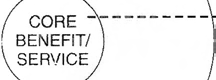
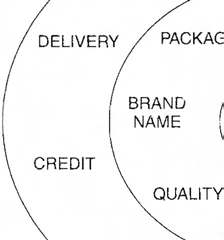
There are four levels of a product: core, tangible, augmented, and promised (see Fig-
ure 7.1). We begin with the notion of the core product, which identifies what the consumers feel they are getting when they purchase the product. The core benefits derived when an overweight 45-year old male purchases a $250 ten-speed bicycle is not transportation; it is
the hope for better health and improved conditioning. In a similar vein, that same individ-
ual may install a $16,000 swimming pool in his backyard, not
order to obtain exercise,
but to reflect the status he so desperately requires. Both are legitimate product cores. Because the core product is so individualized, and oftentimes vague, a full-time task of the marketer
is to accurately identify the core product for a particular target market.
Once the core product has been indicated, the tangible product becomes important.
This tangibility is reflected primarily in its quality level, features, brand name, styling, and packaging. Literally every product contains these components to a greater or lesser degree.
Unless the product is one-of-a-kind (e.g., oil painting), the consumer will use at least some
of these tangible characteristics to evaluate alternatives and make choices. In addition, the
importance of each will vary across products, situations, and individuals. For example, for
Mr. Smith at age 25, the selection of a particular brand of new automobile (core product =
transportation) was based on tangible elements such as styling and brand name (choice =
Corvette); at age 45, the core product remains the same, while the tangible components such
as quality level and features become important (choice = Mercedes).
At the next level lies the augmented product. Every product is backed up by a host
of supporting services. Often, the buyer expects these services and would reject the core-
tangible product if they were not available. Examples would be restrooms and escala-
tors/elevators in the case of a department store, and warranties and return policies in the
case of a lawn mower. Dow Chemical has earned a reputation as a company that will bend
over backwards in order to service an account. It means that a Dow sales representative
will visit a troubled farmer after-hours in order to solve a serious problem. This extra serv-
ice is an integral part of the augmented product and a key to their success.
a world with
many strong competitors and few unique products, the role of the augmented product is
clearly increasing.








154
Describe what you're looking for in as much detail as you'd like.
Our AI reads your request and finds the best matching books for you.
Popular searches:
Join 2 million readers and get unlimited free ebooks